 Anticipate business risks and minimize potential damage
Risk Management
Anticipate business risks and minimize potential damage
Risk Management
Risk management involves anticipating potential future risks and implementing measures to minimize the impact if those risks materialize. It is an critical practice for organizations to maintain stable economic and business operations.
What is Risk Management?
Risk management is the process of anticipating risks that may occur in the future and taking measures to minimize the impact if they do occur.
In the context of information security, risk management begins with identifying threats that could affect the information assets to be protected and evaluating the potential impact if those threats materialize (risk assessment). Based on the level of impact, appropriate controls are then implemented to minimize the risks.
Risk management is not something that can be completed with a one-time effort. In the field of information security in particular, if you are not continuously and proactively implementing measures, you will not be able to respond to new threats as they emerge. As the environment changes, ongoing review and improvement are required.
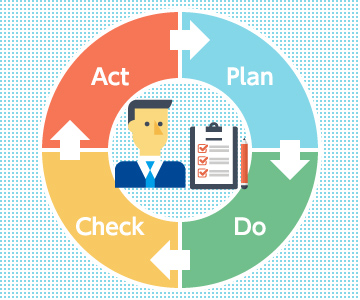
To continuously maintain and improve the level of achievement of security objectives within an organization, the PDCA cycle—Plan (planning), Do (implementation), Check (inspection/audit), and Act (review/improvement)—must be repeated on an ongoing basis.
Asgent provides a wide range of support services to help organizations implement appropriate risk management.
- Organizations that want to undergo an audit or establish an audit framework
- Organizations that want to strengthen their security framework
- Organizations that want to obtain certification
Features of Asgent’s Risk Management
-
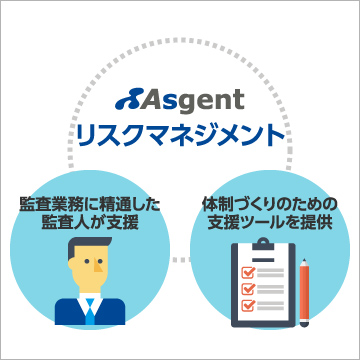
Support from Auditors with Extensive Audit Expertise
Establishing an appropriate organizational framework is essential for effective risk management. Our auditors have extensive experience conducting information security audits for a wide range of organizations, including government agencies, financial institutions, and service companies. They support organizations in building effective frameworks through activities such as internal audits and certification support.
FY2017 “Information Security Audit Company Registry”.
-
Support Tools for Building an Effective Framework
Asgent provides support tools designed to help organizations manage risk more efficiently. Although people ultimately play the most important role in risk management, organizations with limited expertise can use these tools to implement more standardized and consistent security measures.
Services and Products Overview
| Object | Services and Products | |
|---|---|---|
| Prepare for audits / Establish an audit framework | ServiceInformation Security Audit | |
| Strengthen security governance | ProductsM@gicPolicyCoSMO | |
| Obtain certifications | ServiceISO Consulting | |
| ServicePrivacyMark Consulting | ||
| ServicePCI Data Security Standard Consulting |
 Connected Car
 File Sanitization
 Targeted Attack Protection
 Web Security
 Email Security
 Mobile
 Cloud
Cloud Security Assessment
 Risk Management
 For Local Governments
 Supply Chain
 Zero Trust