 Sophisticated cyberattacks and security measures in the era of hybrid work
Zero Trust
Sophisticated cyberattacks and security measures in the era of hybrid work
Zero Trust
Cyberattacks targeting organizations are increasing year by year, and the methods used are becoming more sophisticated.
With the rise of remote work, cloud adoption, and the widespread use of SaaS, both the locations of connected devices and the destinations of accessed data are becoming more diverse. In this context, the concept of "zero trust" has emerged as a key framework for modern security strategies.
What Is Zero Trust?
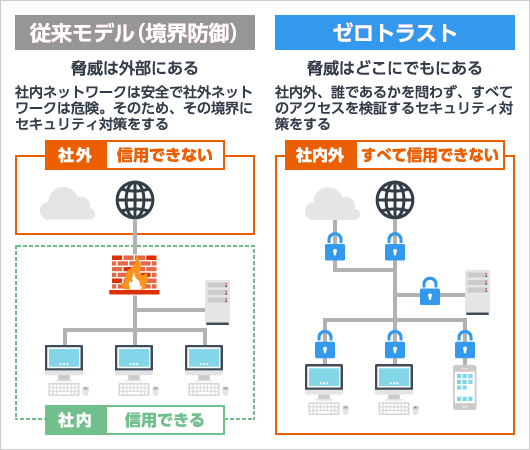
In the zero trust model, security threats are assumed to exist not only outside the corporate network but also within it, and every user or device attempting to access protected internal resources is treated as untrusted and must be verified. Traditional perimeter-based security models are built on the assumption that critical information assets are located inside the network perimeter and that threats originate from outside. However, with the growing adoption of cloud services and the diversification of work environments, such as remote work, the boundary between internal and external networks has become increasingly blurred, making conventional security measures less effective.Against this backdrop, the concept of zero trust has gained significant attention.
Advantages and Challenges of Zero Trust
・Supports Diverse Work Styles While Maintaining Security
By implementing zero trust security, organizations can continuously authenticate users and devices regardless of whether access originates from inside or outside the corporate network, helping ensure secure access to internal resources. The same authentication can also be applied to personal devices as well as company-issued devices, enabling secure BYOD.
・Enables Secure Use of Cloud Services for Business
Communications with cloud services are also subject to security checks, so access to cloud services is strictly verified and authenticated regardless of where it originates or who is attempting to connect. This enables organizations to use cloud services for business with greater confidence, even if they previously hesitated to adopt them due to security concerns.
・Integrates Security Management and Improves Operational Efficiency
In traditional perimeter-based security models, deploying and operating security devices requires complex configuration for each individual device. In a zero trust security model, security functions are integrated in the cloud and strict authentication is applied consistently to all access, helping streamline security operations and management.
Challenges
・Higher costs and longer implementation time
A zero-trust network cannot be achieved by simply deploying a single solution. To realize zero trust, it is necessary to build an environment by combining multiple solutions and services, starting with authentication. As a result, migrating from a traditional perimeter-based model to a zero-trust network requires both time and cost.
・Potential Impact on Convenience
Zero trust security is based on continuously authenticating all access in order to strengthen security. Because authentication may also be required for systems that users were previously able to access without interruption, convenience may be reduced to some extent.
Solutions for Implementing Zero Trust
Based on materials from IPA (Information-technology Promotion Agency, Japan), specifically the "Zero Trust Implementation Guide" and "Introduction to Zero Trust," the following are examples of solutions that help realize zero trust.
-
SASE
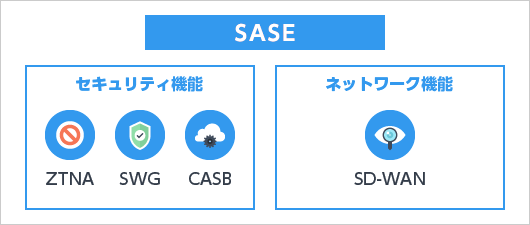
SASE (Secure Access Service Edge) is a concept that integrates network and security functions, traditionally provided separately, into a single cloud-delivered service. SASE is based on the zero trust principle that perimeter-based defenses designed only for internal environments are no longer sufficient now that work is no longer confined to the office. By enabling unified management network and security functions in the cloud, SASE addresses the challenge and can be considered an all-in-one service that allows secure system access regardless of the location of users or devices. - Main components of SASE
・ZTNA((Zero Trust Network Access)
This service controls user access at the application and data level in line with zero trust principles.
・SWG(Secure Web Gateway)
A service primarily designed to protect web traffic by providing capabilities such as web access control and visibility.
・CASB(Cloud Access Security Broker)
This service provides centralized management by visualizing and controlling the use of all cloud services.
・SD-WAN(Software Defined Wide Area Network)
This service builds a virtual WAN on top of physical networks and uses software to monitor and control communications. - - Check Point’s SASE solution, combining SWG and ZTNA capabilities, with deployments at more than 3,000 organizations worldwide
- - Continuous authentication through granular device policy checks
- - A licensing model that supports deployment starting from as few as 10 users
-
EDR/EPP (Endpoint Security)
Under the zero trust model, communications from all endpoints such as PCs, servers, and mobile devices are not trusted by default and must be verified, regardless of whether they originate inside or outside the organization. EDR (Endpoint Detection and Response) is a solution designed to detect suspicious behavior on endpoints and enables rapid response to prevent the spread of damage. EPP (Endpoint Protection Platform) refers to solutions that detect and prevent malware infections, such as traditional antivirus. In many cases, EPP functions are included as part of EDR products.
ProductKey Features of Check Point Endpoint
- - Provides an all-in-one package of the endpoint security capabilities organizations need, from threat prevention and unauthorized access protection to post-infection response and investigation, encryption, and endpoint management
- - Addresses ransomware damage with automatic remediation capabilities
- - Detects phishing websites using an up-to-date threat intelligence knowledge base
- - Reduces operational TCO through a comprehensive management console
Check Point
Endpoint Security
-
File Sanitization Solutions
The zero trust principle of "never trust, always verify" aligns closely with Votiro’s file sanitization solution which proactively prevents attacks by neutralizing all incoming files from external sources across various channels such as email and the web.
ProductThis is a new type of anti-malware solution that focuses on the possibility that files may contain malicious code or malware, and sanitizes (neutralizes) email attachments and files downloaded from the internet. Learn MoreVOTIRO Secure File Gateway
Check Point SASE
 Connected Car
 File Sanitization
 Targeted Attack Protection
 Web Security
 Email Security
 Mobile
 Cloud
Cloud Security Assessment
 Risk Management
 For Local Governments
 Supply Chain
 Zero Trust