 Preparing for Advanced Persistent Threats (APTs) requires the implementation of a holistic, multi-layered security framework
Countermeasures Against Targeted Attacks
Preparing for Advanced Persistent Threats (APTs) requires the implementation of a holistic, multi-layered security framework
Countermeasures Against Targeted Attacks
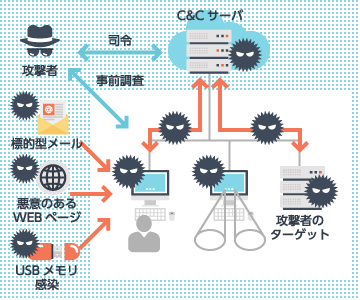
A targeted attack does not refer to a single attack technique. Rather, it encompasses a series of persistent and sophisticated attacks carried out with strong intent, in which adversaries continuously employ multiple methods until their objectives are achieved.
A primary example involves cyberattacks that infiltrate a target organization’s network through diverse vectors – such as email, social media, or malicious websites – to exfiltrate sensitive data. However, thwarting a single attack vector does not end the threat; the adversary will simply pivot to another method. This necessitates proactive preparation for the next evolution of the attack. Consequently, defending an organization against such targeted threats requires more than isolated security measures. It demands a “Defense-in-Depth” strategy – a multi-layered architecture that integrates countermeasures for u known threats with early detection capabilities to identify anomalies at their onset.
Defense Against Targeted Attacks
Targeted attacks are cyberattacks directed at specific companies or organizations. While many are aimed at stealing information of high monetary value, others are driven by ideological motives, as seen in attacks by Anonymous, where targets are selected because they conflict with the attackers’ beliefs, principles, or sense of justice. The attack methods used are highly diverse and extremely persistent, with adversaries repeatedly employing different techniques until their objectives are achieved. Typical examples include “Spear Phishing” that exploits social engineering and “Watering-Hole” attacks that deliver malicious programs by luring users to compromised websites.
Because these varied and sophisticated attacks continue until their objectives are achieved, it is impossible to completely prevent all attacks through “Perimeter Defense” measures such as firewalls and IPS alone. Organizations therefore need a multi-layered “Defense-in-Depth” approach that combines a variety of security measures beyond perimeter defenses.
Asgent provides comprehensive Defense-in-Depth strategies by integrating a diverse portfolio of products and services. Our approach ranges from perimeter defense, which blocks suspicious traffic, to proactive countermeasures against unknown threats and specialized CSIRT establishment support. By orchestrating these multiple layers of protection, we deliver a robust security posture capable of thwarting today’s most sophisticated attacks.
We offer a strategic framework to fortify your security posture:
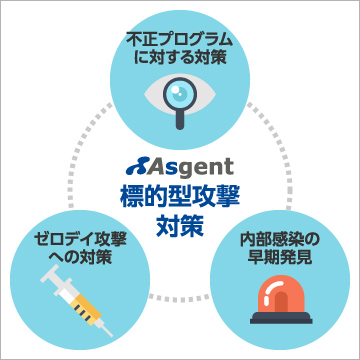
- Proactive Prevention and Mitigation: Detect early signs to neutralize threats and minimize impact.
- Counter Unknown Threats: Deploy advanced protection against zero-day exploits.
- Rapid Detection: Instantly identify malware infiltration and attack traces.
- Targeted Attack Countermeasures for Ransomware Defense
In recent years, ransomware has become one of the most pervasive and damaging cyber threats. This category of malware encrypts critical data, rendering systems inoperable, and subsequently demands a ransom in exchange for the restoration of access.
More recently, ransomware attacks have become increasingly sophisticated and malicious. In addition to data encryption, so called “Double Extortion” tactics have been observed, in which attackers exfiltrate data prior to encryption and threaten to publicly disclose it unless the ransom is paid. While ransomware was once dominated by high-volume, “spray-and-pray” email campaigns, the focus has shifted to “Targeted Ransomware”. Adversaries now exploit system vulnerabilities or compromised credentials to infiltrate networks and move laterally to infect servers and workstations – tactics epitomized by groups like LockBit and Conti. Consequently, effective ransomware defense is now inseparable from advanced anti-targeted attack strategies.
Asgent’s Targeted Attack Solutions: Three Key Pillars
-
Countermeasures against C&C Server Communications and Malicious Programs Including Bots and Ransomware
Since most targeted attacks infect host PCs to establish connectivity with a Command and Control (C&C) server – enabling attackers to hijack systems, laterally spread malware across the network, and exfiltrate sensitive data – it is imperative to implement traffic monitoring for early anomaly detection and proactive blocking of illicit communications based on the latest threat intelligence. -
Zero-Day Threat Mitigation
To effectively mitigate zero-day attacks, organizations should implement a framework that ensures safe data utilization by systematically vetting all files – whether received from external sources via email and social media or exchanged internally – through automated sanitization (Content Disarming) or risk assessment within a secure sandbox environment. -
Rapid Detection of Internal Infiltration
In recent targeted attacks, attackers often remain undetected for extended periods while gathering information, and the extent of the damage tends to increase in proportion to the length of this dwell time. To minimize actual damage, it is important to continuously monitor traffic within the network, detect suspicious and irregular communications or behavior as early as possible, perform risk analysis and identify infected devices, quickly gain an accurate understanding of the current situation, and take initial response actions as early as possible.
Services & Products Portfolio: Comprehensive Overview
| Objective | Products & Services | |
|---|---|---|
| Early Detection of Attacks and Damage Mitigation | ServiceManaged Security Service | |
| ProductCheck Point Quantum Security Gateway | ||
| Countermeasures Against Unknown Threats | ProductCheck Point SandBlast TE Appliances | |
| ProductVotiro Secure File Gateway | ||
| Building and Operating a Moniroting System | ServiceSecurity Plus Managed Security Service |
Services & Products by Objective
Attack Detection and Damage Mitigation
Details
Security Plus
Managed Security Service

Details
Check Point
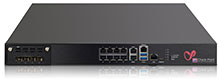
Quantum Security Gateway
Countermeasures Against Unknown Threats
Check Point
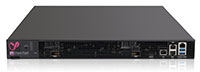
SandBlast TE Appliances
Details
Votiro Secure File Gateway

Building and Oprating a Monitoring System
Details
Security Plus
Managed Security Service
 Connected Car
 File Sanitization
 Targeted Attack Protection
 Web Security
 Email Security
 Mobile
 Cloud
Cloud Security Assessment
 Risk Management
 For Local Governments
 Supply Chain
 Zero Trust