 Strengthening the security of critical email communications
Email Security
Strengthening the security of critical email communications
Email Security
Email is as an essential infrastructure for business operations. While it is extremely convenient, it also presents a number of security challenges. By strengthening email security measures, organizations can protect themselves from information leaks, fraud, and other risks.
What Are Email Security Countermeasures?
Email is often used to exchange highly sensitive information. Email addresses themselves are considered personal data, and email is also one of the tools most frequently abused by attackers to deliver malware. For these reasons, robust security measures are required.
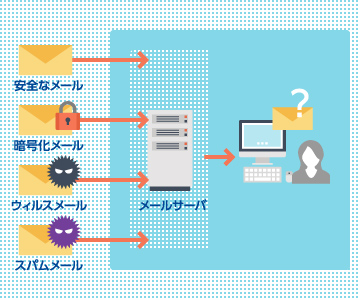
Organizations need to implement measures to protect against inbound threats such as business email compromise (BEC) using spoofed identities, and targeted attack emails with malware attachments, as well as measures to prevent misdirected emails so that important information is not sent to the wrong recipient.
Malware countermeasures in particular are critical for organizations of all sizes and industries. Once malware enters a system, the infected system can become a launchpad for attacks that may even impact business partners.
Asgent’s email security solutions provide comprehensive protection for both inbound and outbound communications across the organization.
We propose optimal mechanisms for email security solutions. Our solutions help you:
- Ransomware and Email Security
Ransomware has emerged as a rapidly growing cyber threat in recent years.
Ransomware is a form of malware that encrypts data stored on devices so that it cannot be used, then demands a ransom in exchange for restoring access. More recently, attacks have become even more malicious and sophisticated. For example, in so-called double extortion schemes, attackers first steal data before encrypting it, then threaten to publish the data if the victim does not pay.
One of the primary infection vectors for ransomware is email. Attackers distribute ransomware through email attachments or links embedded in email messages. The emails used in these attacks are increasingly sophisticated, making it difficult to identify them as malicious based on wording or sender information alone.
For these reasons, strengthening email security is also an effective measure from the perspective of ransomware protection.
Asgent’s Email Security Countermeasures
-
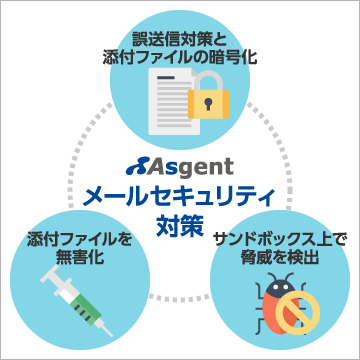
Sanitizing Email Attachments
Many targeted attacks use clever techniques to disguise malicious emails as legitimate ones, infect endpoints with malware, and steal confidential information. Because many of these attacks include zero-day exploits using unknown malware, it is becoming extremely difficult to detect them with antivirus solutions alone.
Asgent’s solutions focus on the possibility that threats may be hidden in files and sanitize files in advance. This approach protects networks from both known and unknown malware threats, enabling safe exchange of documents and other files without impacting business efficiency. -
Detecting Threats Through Sandbox Emulation
To identify new malware for which no signatures are yet available, it is necessary to emulate their behavior in an isolated virtual environment, or sandbox. Asgent’s sandbox solutions can be deployed flexibly according to your environment, either as a cloud service or as dedicated on-premises appliances. -
Detecting Spoofed Emails (Business Email Compromise)
According to the Information-technology Promotion Agency, Japan (IPA), “damage caused by Business Email Compromise (BEC)” ranked second among information security incidents considered to have had a significant social impact in 2018. Business Email Compromise is a form of fraud in which attackers impersonate overseas business partners, company executives, or other trusted parties and send fraudulent emails requesting payments or fund transfers. Significant financial losses have also been reported in Japan. Sophisticated phishing emails may evade conventional email security products, reaching employees even at large organizations that have security measures in place. Asgent’s solution uses machine learning to learn the characteristics of each user’s mailbox. Based on the learned information, it detects impersonation—a common technique used in Business Email Compromise—and warns recipients, helping to prevent damage caused by BEC. -
Automating Phishing Email Response
Today’s mass-distributed phishing emails can easily bypass email gateways, leading to credential theft and malware infections. Even when an employee recognizes a suspicious email and reports it, damage may already occur while the security team spends time identifying other recipients. Asgent’s solution uses a report from a single employee as a trigger to instantly identify other recipients and remove the malicious email from their mailboxes. This significantly reduces both the time required from reporting to removal and the workload on the security team. -
Preventing Email Misdelivery and Encrypting Attachments
In many organizations, internal policies require employees to check the recipients, message content, and attachments before sending emails. However, simply establishing such rules does not eliminate the risk of misdirected emails. In addition, an increasing number of companies require email attachments to be encrypted before being sent, but human error cannot be completely prevented. By deploying the appliance provided by Asgent, users can reconfirm recipients and other details before sending emails as a measure against misdelivery. The appliance can also automatically encrypt attachments, enabling the secure transmission of email.
 Connected Car
 File Sanitization
 Targeted Attack Protection
 Web Security
 Email Security
 Mobile
 Cloud
Cloud Security Assessment
 Risk Management
 For Local Governments
 Supply Chain
 Zero Trust