 Visibility and automated protection of external assets from an attacker’s perspective
IONIX Exposure Management (ASM)
Visibility and automated protection of external assets from an attacker’s perspective
IONIX Exposure Management (ASM)
Interop 2024 - Best of Show Award -Runner-Up Award-Winning ProductSecurity (Enterprise) Category
- Attack surface discovery
Identify domains, IP addresses, and other assets that are accessible from the Internet. - Attack surface information collection
Collect information such as software configurations through non-disruptive scanning. - Attack surface risk assessment
Correlate the collected information with vulnerability data, prioritize the identified risks, and take appropriate action.
The greatest risk is the attack surface you cannot see
Why organizations need ASM
The widespread adoption of cloud services and SaaS, together with IT operations distributed across multiple group companies and contractors, has significantly expanded the range of assets that organizations must manage.
As a result, unmanaged assets and shadow IT have become targets for attackers, while exposure caused by zero-day vulnerabilities and configuration errors is also increasing. Many of these assets remain publicly accessible without adequate security measures. In some cases identified through Asgent’s free ASM Check-Up analysis service, staging environments that should not have been publicly accessible were found exposed on the Internet.
What is ASM?
As organizations face growing demands for stronger security, Attack Surface Management, or ASM, provides an effective proactive security approach.
IONIX is an ASM tool that provides visibility and automated protection for external assets from an attacker’s perspective. It continuously identifies potential vulnerabilities and attack exposure across an organization’s cloud-native environment as they appear to external attackers.
IONIX assigns scores based on potential business impact, enabling organizations to prioritize risks and apply automated protection.
Common challenges
| Lack of visibility into external assets | Shadow IT | Difficulty prioritizing risks |
|---|---|---|
| System administrators are distributed across the corporate group, making it difficult to maintain a centralized view of domains, cloud environments, certificates, and other assets. | Unexpected attack targets, such as development environments and abandoned servers, may remain publicly accessible. | Large numbers of vulnerabilities may be detected, making it difficult to prioritize them according to their business impact. |
Comprehensive attack surface management with IONIX
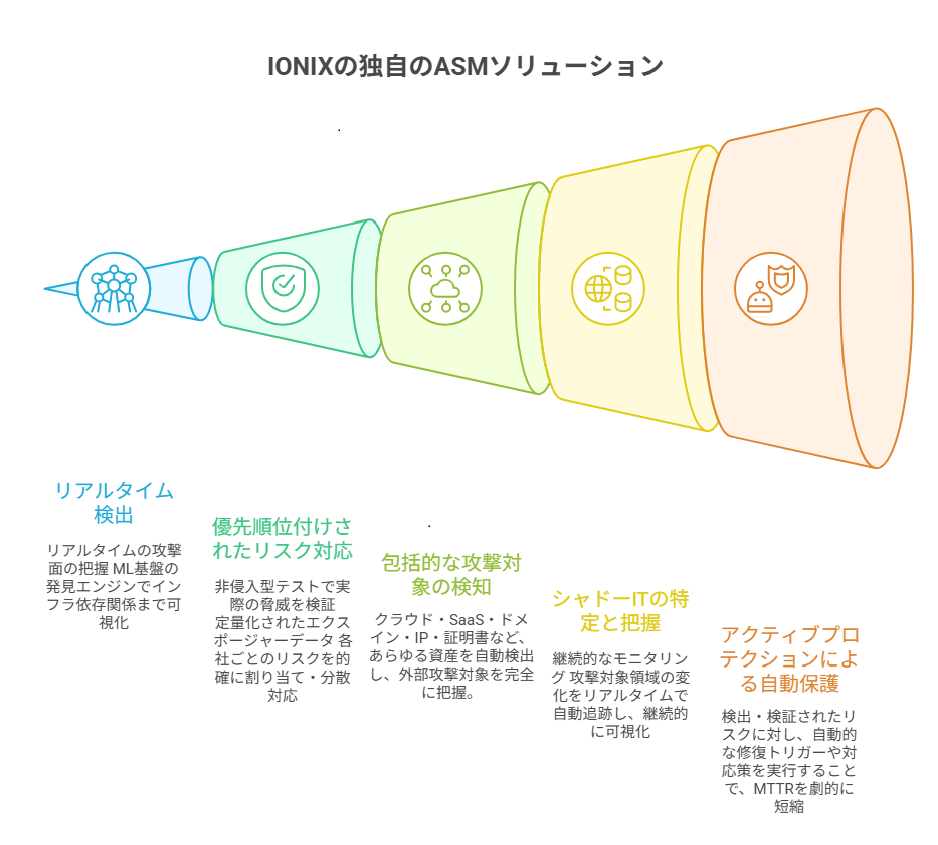
Effective threat exposure management
IONIX continuously discovers and assesses the external attack surface, improving visibility into threats and strengthening the organization’s ability to respond.
| Real-time attack surface visibility | Prioritized risk response | Quantified exposure data |
|---|---|---|
| A machine learning-based discovery engine provides visibility into infrastructure dependencies. | Non-disruptive testing validates actual threats. | Risks can be accurately assigned to the appropriate companies, enabling distributed response. |
Comprehensive attack surface discovery
IONIX automatically discovers assets across cloud services, SaaS environments, domains, IP addresses, certificates, and other resources, providing a comprehensive view of the external attack surface.
| Unified visibility across siloed assets | Identification and visibility of shadow IT | Continuous monitoring |
|---|---|---|
| Discover and visualize all externally connected assets, including assets in cloud environments, assets operated by third-party vendors, and assets managed by group companies. | Provide visibility into hidden attack targets. | Automatically track changes to the attack surface in real time and maintain continuous visibility. |
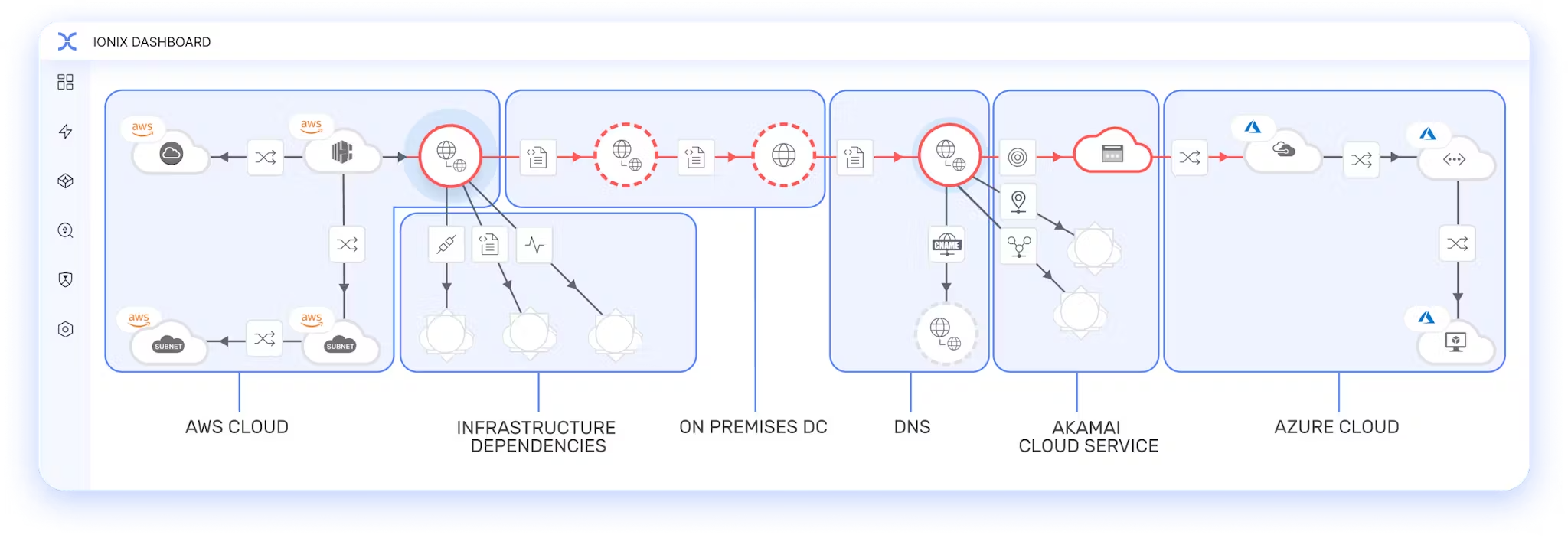
Attack surface mapping
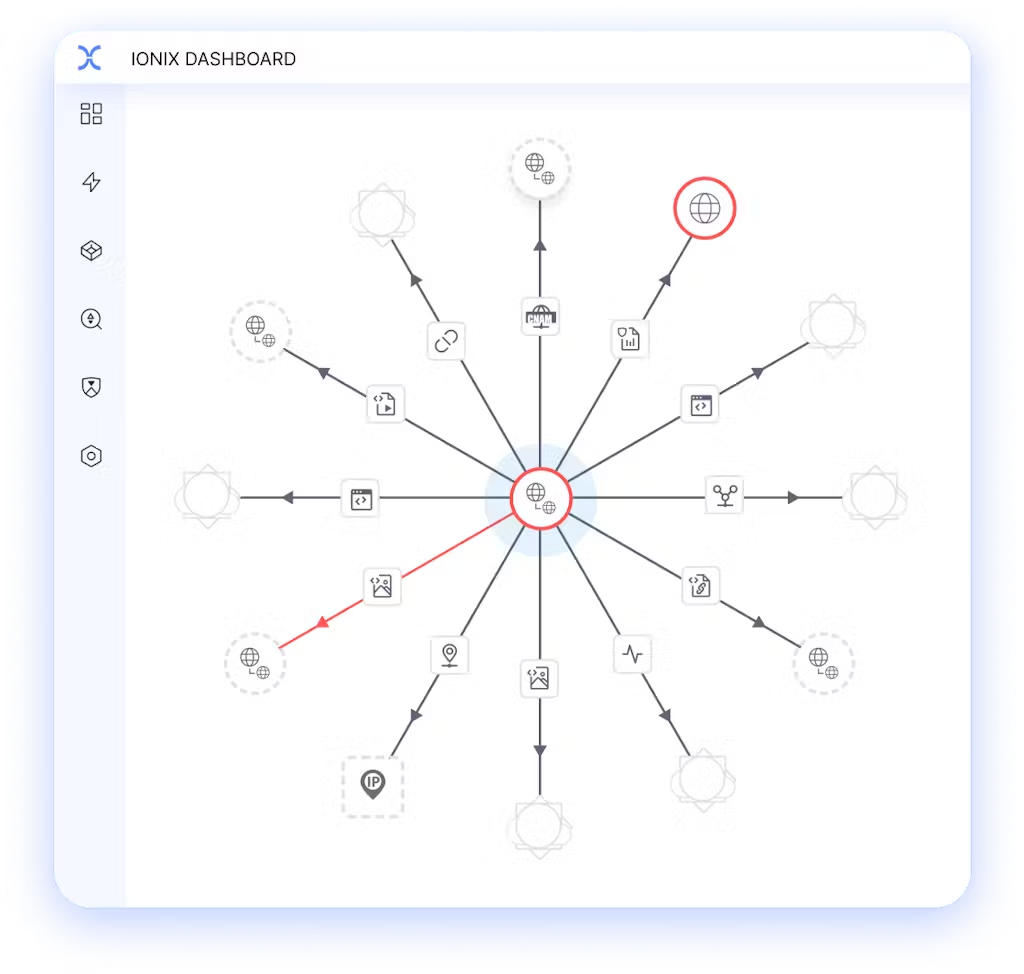
IONIX maps exploitable attack paths and exposures, connecting them with prioritization and response.
| Identification of entry points and exploit chains | Assessment of business impact | An automated process from discovery to remediation |
|---|---|---|
| Map attack paths based on asset dependencies and visualize potential entry routes from an organization’s external assets into its internal environment. | Calculate risk priorities based on business impact and determine which assets could have an actual effect on operations. | Validate vulnerabilities through non-disruptive simulations, and then trigger remediation workflows with a single click. |
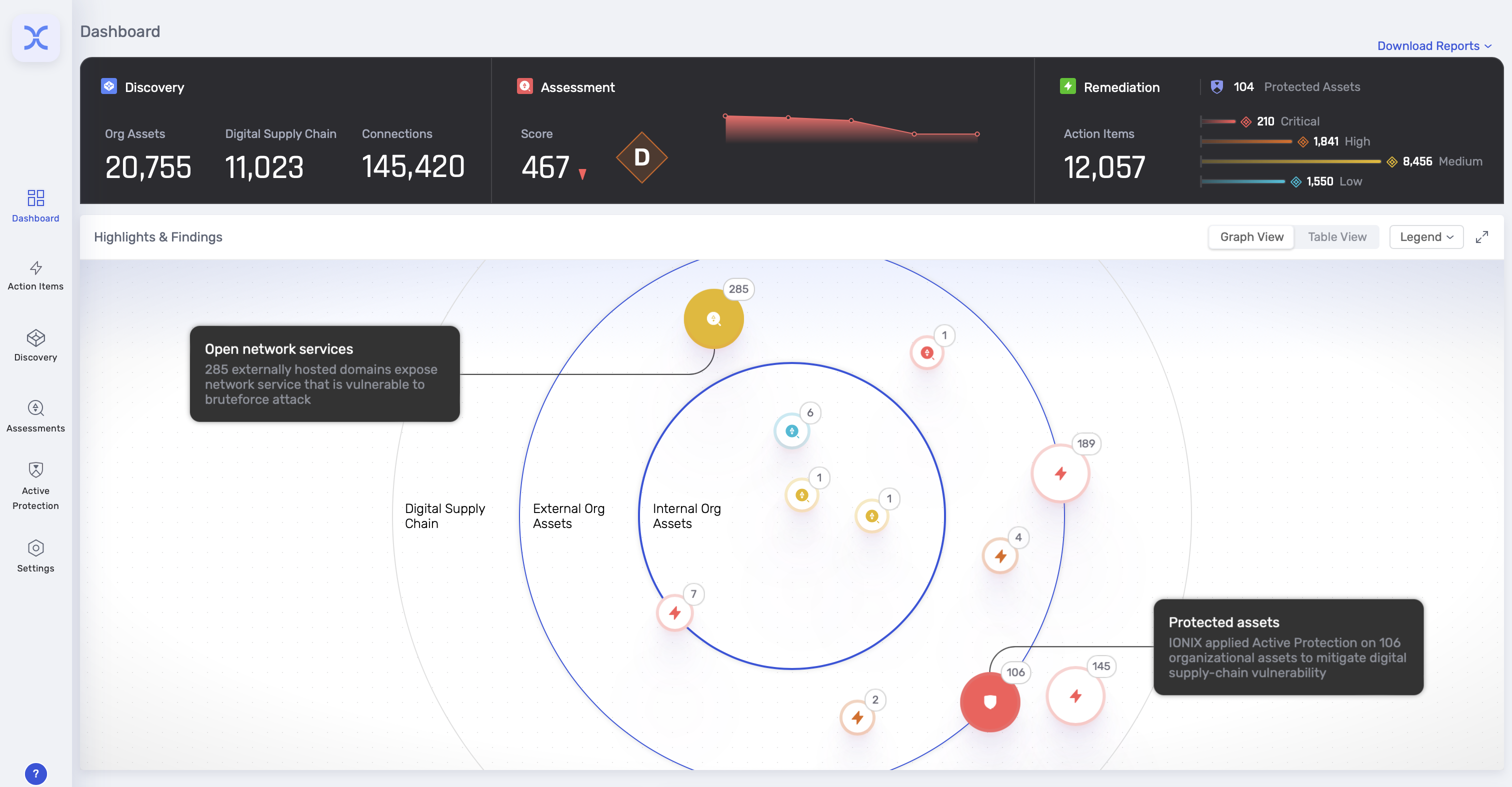
Automated protection with Active Protection
IONIX dramatically reduces mean time to remediation (MTTR) by automatically triggering remediation actions and other countermeasures for detected and validated risks.
| Automated protection of vulnerable assets | Blocking the risk of asset takeover | Fully automated vulnerability mitigation |
|---|---|---|
| Automatically protect assets at risk of exploitation, including assets affected by dangling DNS records or exposed S3 buckets. | When indications of abuse, such as malware deployment or DNS hijacking, are detected, IONIX automatically applies containment measures before the asset is compromised. | Automatically mitigates detected vulnerabilities without requiring user action. |
Why organizations choose IONIX
| Validation from an attacker’s perspective | Management by subsidiary | Prioritization based on business impact |
|---|---|---|
| IONIX goes beyond simply identifying vulnerabilities by assessing whether they can actually be exploited. It validates real attack paths and identifies the vulnerabilities that present genuine risk. | IONIX supports centralized management and distributed response across multiple legal entities, enabling organizations to manage the security posture of the entire corporate group under a consistent framework. | IONIX assesses risk based not only on technical vulnerability scores but also on actual business impact, helping organizations maximize security effectiveness with limited resources. |
Security Products
- Next-Generation Firewall
- Targeted Attack Protection
- Cloud Security / Virtualization
- Mobile / Endpoint Security
- Email Security
- Anti-Phishing
(BEC etc.) - Application Security
- Server Security
- Sandbox
- File Sanitization
- Log Analysis
- Server Monitoring
- Encryption
- Security Policy
- Industrial Control System Security
- Connected Car Security
- WAAP
- Browser Security
- Cloud Backup
- SASE
- ASM
- Vulnerability Management
- Security for AI