 Host-based server security solution to address security challenges across virtual, cloud and physical
Trend Micro Deep Security
Host-based server security solution to address security challenges across virtual, cloud and physical
Trend Micro Deep Security
Trend Micro Deep Security (Deep Security) delivers the key capabilities required to protect servers, including IPS/IDS, firewall, change monitoring for files and registries, security log monitoring, and anti-malware. By utilizing agents and virtual appliances, it provides integrated server security across physical, virtualized and cloud environments.
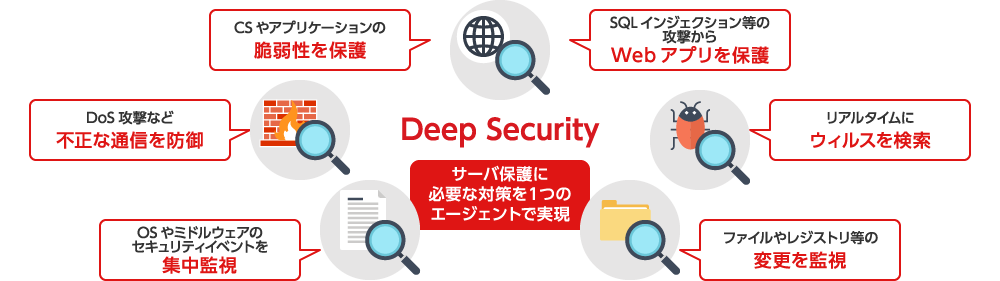
Key Features of Trend Micro Deep Security
-
Protect Servers with Agent-Based and Virtual Appliance Modules
Deep Security protects physical servers, virtual environments, and cloud environments through agent-based (host) and Virtual Appliance-based protection modules, providing security measures tailored to each environment. Because all protection modules are software-based, there is no need to change your network architecture when deploying. You can install only as many modules as you need, on the servers that require protection. All of these modules are centrally managed by the Deep Security Manager, allowing you to enforce unified security policies across your entire server environment.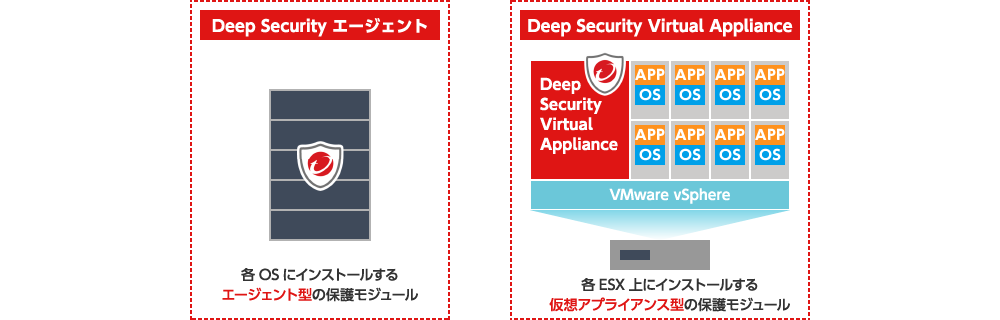
-
Protect Critical Servers with Six Essential Security Functions
Deep Security provides the following six capabilities required for robust server security. From the network layer up through the operating system and application layers, it enables true multi-layered protection for your servers:
■Anti-Malware with Web Reputation
■Web Application Protection
■Intrusion Detection and Prevention (Host-based IDS/IPS)
■Firewall
■File and Registry Integrity Monitoring
■Security Log Monitoring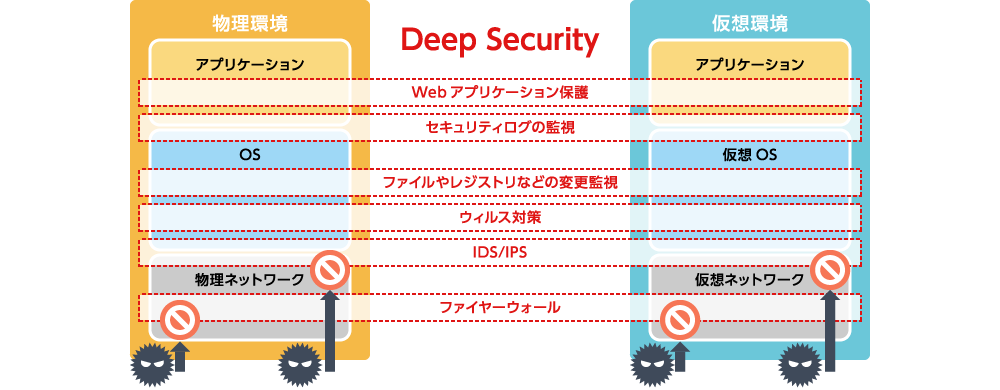
-
Support for a Wide Range of Server OS
The Deep Security Agent supports major server operating systems, including Windows, Linux, and Solaris. For Linux, it supports five distributions: Red Hat, SUSE, CentOS, Ubuntu, and Amazon Linux.
It also protects against vulnerabilities in more than 100 applications running on these operating systems. As organizations face increasing challenges in managing security across diverse environments, Deep Security provides an effective solution for protecting mixed server environments.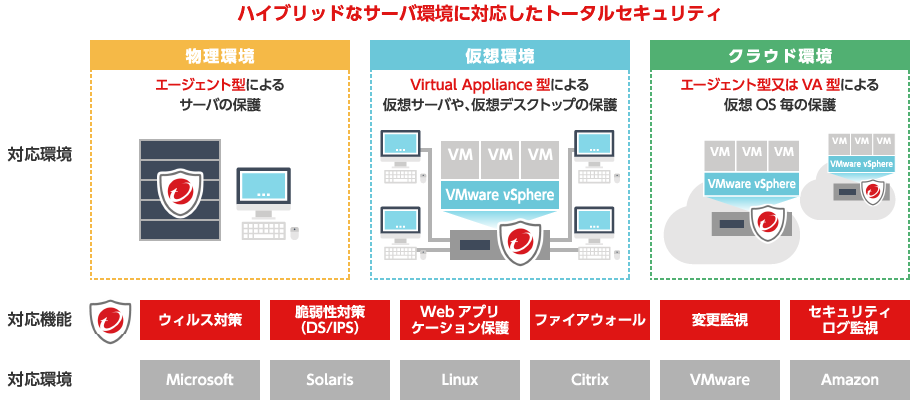
Product Lineup
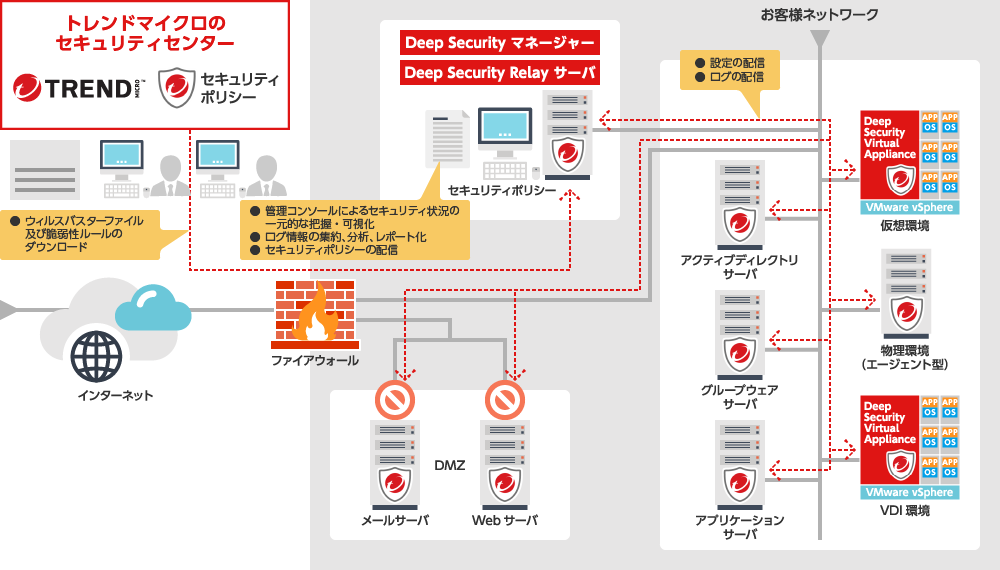
| Deep Security Agent | Deep Security Agent is a software-based protection module installed on the operating system. It supports major server operating systems, including Windows, Linux, and Solaris, and provides six security functions: antivirus, IDS/IPS, web application protection, firewall, integrity monitoring, and security log monitoring. |
|---|---|
| Deep Security Virtual appliance | Deep Security Virtual Appliance is a virtual appliance-based protection module installed on each ESX host. By intercepting network traffic and file I/O at the hypervisor level, it provides antivirus, IDS/IPS, web application protection, firewall, and file integrity monitoring without requiring agent-based security software to be installed on each virtual operating system. |
| Deep Security Manager | Deep Security Manager is the management server for Deep Security protection modules, including agents and virtual appliances. It distributes configuration settings to each protection module and centrally stores detected events and logs. The Manager can also be configured for redundancy. Protection modules automatically recognize the redundant Manager configuration and communicate with the secondary server if one Manager goes down. Even if both servers become unavailable, the protection modules themselves continue to function. |
| Deep Security Relay | Deep Security Manager is the management server for Deep Security protection modules, including agents and virtual appliances. It distributes configuration settings to each protection module and centrally stores detected events and logs. The Manager can also be configured for redundancy. Protection modules automatically recognize the redundant Manager configuration and communicate with the secondary server if one Manager goes down. Even if both servers become unavailable, the protection modules themselves continue to function. |
Security Products
- Next-Generation Firewall
- Targeted Attack Protection
- Cloud Security / Virtualization
- Mobile / Endpoint Security
- Email Security
- Anti-Phishing
(BEC etc.) - Application Security
- Server Security
- Sandbox
- File Sanitization
- Log Analysis
- Server Monitoring
- Encryption
- Security Policy
- Industrial Control System Security
- Connected Car Security
- WAAP
- Browser Security
- Cloud Backup
- SASE
- ASM
- Vulnerability Management
- Security for AI